
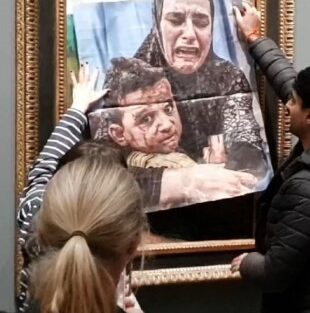
Activists plastered Picasso masterpiece with Gazan mother and child poster
Two pro-Palestine activists covered a Picasso painting with a picture of a Gazan mother and child before pouring red paint on the National Gallery floor, a court heard.
NHS worker Jai Halai, 25, and politics student Monday-Malachi Rosenfeld, 23, plastered the poster over the glass cover of the 1901 masterpiece ‘Motherhood’ on 9 October 2024.
Footage played in court shows security guards unsuccessfully trying to pull the pair away from the painting as they unveiled the picture of the Palestinian mother.
They then poured water-based paint over the wooden flooring before chanting ‘Free Palestine’ as they were taken away from the gallery.
In another clip, the protesters were heard shouting: ‘The UK is complicit in genocide… [in Palestine] women are giving birth without any medical attention.
‘87 per cent of the public support an arms embargo [on Israel].
‘We need a democratic revolution.’
Halai appeared in Southwark Crown Court dressed in a white shirt while Rosenfeld, with blue hair and wearing platform shoes, was permitted to sit outside the dock to aid her hearing.
The protesters, members of the direct action group Youth Demand, deny criminal damage.
Giving evidence, Michael Willie, head of security and facilities at the National Gallery, told jurors no costs would have been incurred if not for paint poured on the floor.
He said: ‘Paint was on the marble skirting, stanchion, rope barriers, and it was seeping into the sockets.’
Asked by prosecutor Toby Manhire how serious the damage is, he said: ‘Just staining in the grains of the marble… the mastic joint, we had to replace it in its entirety.
‘It is safe to assume [the paint] could be cleaned away enough to reopen the gallery.’
Asked if there was an ‘obvious case of permanent damage’, he said: ‘No, not at that point.’
But while the stunt was billed at £8,000 in total, just £271.59 was attributed to cleaning.
Defending Halai, Katie McFadden said it was an ‘aesthetic decision’ to keep the National Gallery ‘looking fancy’.
Jurors heard four workers were paid £120 an hour that evening ‘putting the floor back as a result of the cleaning process that the gallery has undertaken.’
Mr Willie said the works were necessary to ‘ensure the Gallery was presentable to members of the public the next morning.’
He said the works included sanding down the flooring and giving it a new finish because otherwise there would be ‘patches’ left from the cleaning.
Jurors were told the National Gallery incurred £250.28 for ‘response costs’, being the ‘time taken to reopen the gallery.’
But defending Rosenfeld, Laura O’Brien said the Gallery would have been prepared to deal with such incidents with so many visitors every day, adding: ‘Things like that do happen in the National Gallery.’
He said: ‘Not like that but you do get spillages, small ones.’
Halai, of Barnet, north London, and Rosenfeld, of Tower Hamlets, each deny criminal damage.
The trial continues.
ENDS


