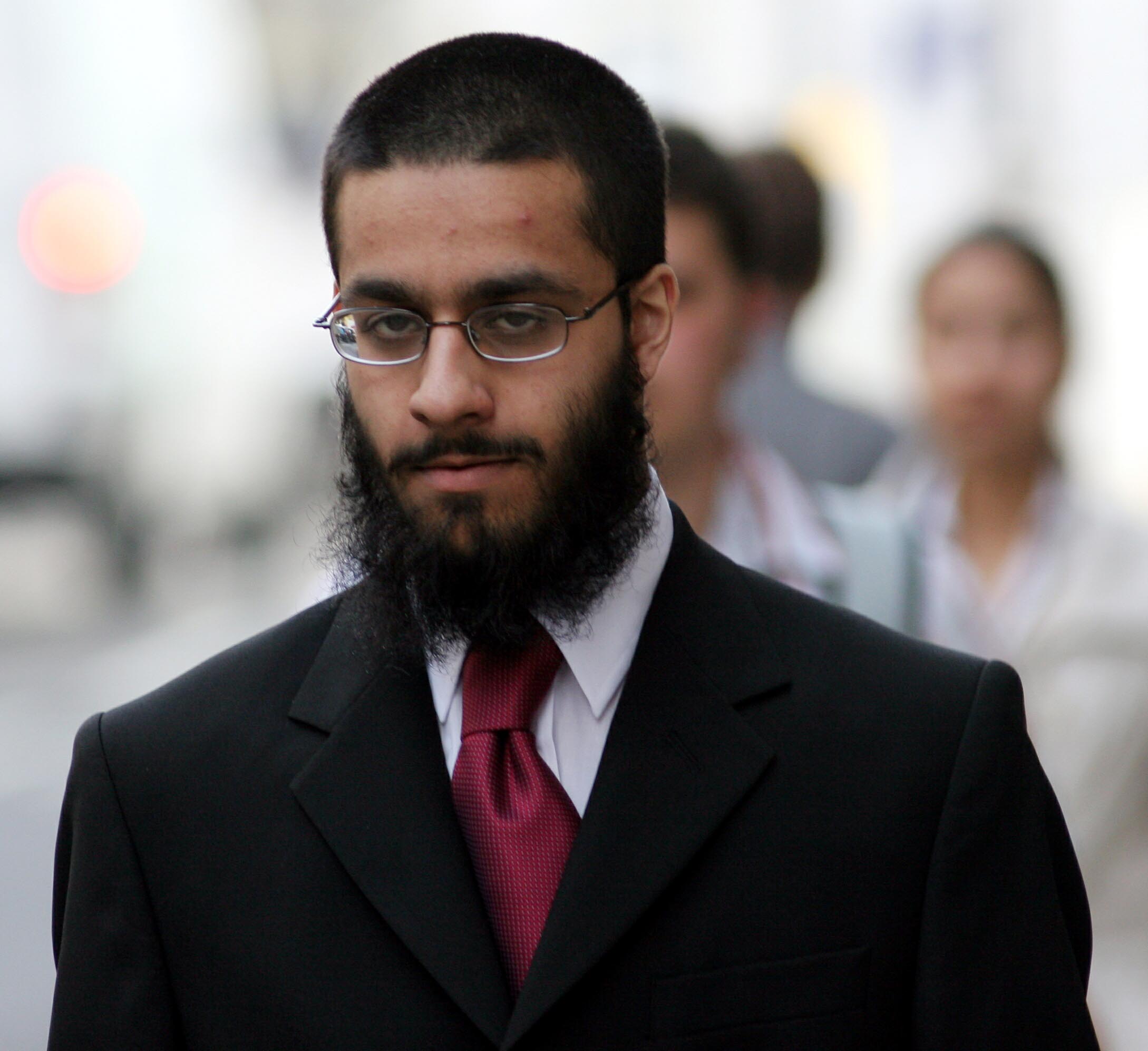
RAJA: MILITANT BRADFORD UNIVERSITY STUDENTS HIJACKED PRAYER MEETING
A group of four young terror suspects hijacked a prayer meeting to demand the death of anyone publishing an anti-Muslim cartoon, a court heard.
Two of the Bradford university students had already been thrown out of the Islamic Society for their extremist views and had not been seen for up to three months.
But Aitzaz Zafar, 18, and Awaab Iqbal, 19, returned to the weekly meetings in February last year with friends Usman Malik, 19, and Akbar Butt, 20, and another unknown student after a Danish newspaper published a cartoon mocking Allah.
With tensions running high among the Muslim community, the group seized their moment and took over the 100-strong meeting when a guest speaker was delayed, the Old Bailey heard.
The controversial prayer and sermon session called for Muslims to ‘utilise force’ against the cartoonist and kill anyone who published it.
But realising what was happening the society’s vice president Imran Raja stepped in to make a statement to distance the society from the comments.
A lively debate broke out between the four students, who were all sat in the front row, and others arguing against what was said.
Malik shouted at them: ‘Nobody likes to hear the truth.’
Society member Joshua Wilson told the court: ‘We decided against any course of immediate action because we didn’t want to cause a scene.
‘When they finished Imran Raja gave a statement that the views expressed were not those of the society.’
He said the audience was ‘concerned’ by what they had heard and the reaction was negative, especially as they had taken over without asking.
Zafar, Iqbal, Malik and Butt are in the dock with Mohammed Raja, 18, accused of compiling terrorist propaganda to encourage youngsters to give up their lives for the Jihad.
Mr Wilson told the court he had become concerned with Zafar and Iqbal’s extremist views after meeting through the university’s Islamic society.
He spent time at their house in Grove Terrace, Bradford, and would play computer games and discuss religion.
But on one occasion towards the end of 2005, Zafar told him Shi’ite Muslims should be targeted because of their collaboration with coalition forces in Iraq.
‘In general people were appalled,’ Mr Wilson told the court.
He said Zafar followed the Salafi Jihadi school of Islamic thought, which was another topic for debate among the young Muslims.
‘It’s a school of thought that says it is legitimate to utilise force to obtain objectives,’ Mr Wilson said.
‘He was proposing that the Jihadi school of thought was a legitimate one.’
Zafar went on to say he supported using ‘force to fight against leaders of countries that seemed not to be following Islam appropriately’.
A few days later Zafar e-mailed his friend a 31-page document entitled ‘Discussion on the Methodology to Establish a Muslim Islamic State’ which encouraged Muslims to fight Jihad in order to promote Muslim beliefs.
Mr Wilson was with Zafar and Iqbal when he found DVDs supporting Jihad near the university prayer room.
When they set out to destroy 10 copies of it, Zafar told Mr Wilson he was ‘harming the Jihadi calling.’
The young Muslim’s concerns were further heightened after a trip to a Muslim community march in London to protest against the Terrorism Act 2006, when Iqbal told him Jihad was ‘the highest form of worship’.
Mr Wilson said: ‘I discussed the situation with a member of the society and what we had talked about and we decided it was appropriate at that time to cease working with them.’
Iqbal, a forensic science student of (24) Grove Terrace, Bradford, and Zafar, of (34) Bishop Street, Rochdale, both deny possessing an article in circumstances that give rise to a reasonable suspicion that their purpose is connected to the commission, preparation or instigation of an act of terrorism between February 23 and March 3 2006 relating to three CDs.
Iqbal alone denies possessing an article in circumstances that give rise to a reasonable suspicion that their purpose is connected to the commission, preparation or instigation of an act of terrorism between January 1 2006 and March 3 2006, relating to discs, a video recording and hard drive.
Zafar alone denies possessing an article in circumstances that give rise to a reasonable suspicion that their purpose is connected to the commission, preparation or instigation of an act of terrorism between January 1 2006 and March 3 2006, relating to the hard drives of two computers and four discs.
Malik, of (A19) Laisteridge Lane, Bradford, denies two counts of possessing an article in circumstances that give rise to a reasonable suspicion that their purpose is connected to the commission, preparation or instigation of an act of terrorism between January 1, 2006, and March 3, 2006, relating to a document called ‘Raising Mujihadeen children’ and ‘joining the caravan’ and a USB drive.
Butt, of no known address, denies two counts of possessing an article in circumstances that give rise to a reasonable suspicion that their purpose is connected to the commission, preparation or instigation of an act of terrorism between January 1, 2006, and March 3, 2006, relating to the hard drive of a laptop.
Raja, of (37) Holcombe Road, Ilford, east London, denies two charges of possessing an article in circumstances that give rise to a reasonable suspicion that their purpose is connected to the commission, preparation or instigation of an act of terrorism.
They relate to three CDs containing Islamic material between December 24, 2005, and February 28, 2006, and documents on a hard drive between January 1, 2005 and February 27, 2006.
The trial continues.
ends