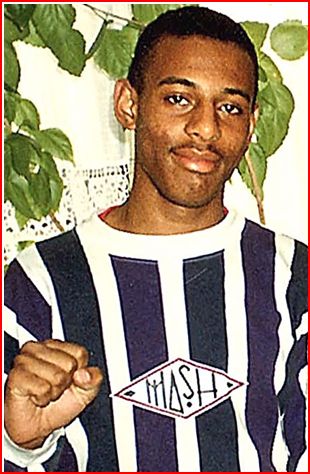
NORRIS:MURDER VICTIM STEPHEN LAWRENCE ‘SWALLOWED UP’ BY MOB OF RACISTS
Teenage murder victim Stephen Lawrence was ‘swallowed up’ by a gang of white youths who shouted racist abuse at him, the Old Bailey heard today (Tues).
Stephen, 18, was forced to the ground and stabbed twice in the upper torso in Eltham, southeast London, on 22 April, 1993.
He had been waiting for a bus with his friend Duwayne Brooks (CORR), also 18, when they were approached by a group of five white males who were heard to shout ‘what, what nigger’.
As the youths ‘rushed’ at the pair, Duwayne was able to get away, but Stephen was surrounded and attacked.
They had been waiting in Well Hall Road around 10.35pm aiming to head back north to Woolwich, jurors were told.
Moments before the attack Stephen and Duwayne had gone to look for a bus.
Describing the scene prosecutor Mark Ellison QC told a jury of nine men and three women: ‘As they reached the area just beyond the junction of Dickson Road and Well Hall Road they turned round and started back towards the bus stop.
‘By the time they reached the area of the zebra crossing there was a group of about five white youths crossing over Well Hall Road towards them.
‘One of the group was heard by Duwayne Brooks to say “what what nigger” and at the same time the whole group suddenly began to rush towards them.
‘A witness as the bus stop also heard something being said from the group but could not make out what it was.
‘Duwayne Brooks turned to Stephen Lawrence and told him to run, but the group caught them at the junction of Dickson Road.
‘It seems Duwayne Brooks may have been ahead of Stephen Lawrence when the group converged on them, but in any event Duwayne Brooks managed to run off north up Well Hall Road, pausing when he reached the bus stop to shout back something like “get up and run Stephen” before Duwayne Brooks continued up Well Hall Road and north of the bus stop.
‘Stephen Lawrence did not manage to get away. The group quickly surrounded him. One witness described that he was swallowed up by the weight of numbers and simply forced to the ground.
‘Then they were leaning over him, there was some hand and leg movements observed from those who could see and we know for a fact he was stabbed twice in the upper torso.’
Gary Dobson, 36, and David Norris, 35, are accused of being part of that group which attacked Stephen 18 years ago.
Earlier Mr Justice Treacy warned the jury after they had been sworn in that the case would be nothing like the television programme ‘The Jury’ which was aired last week.
‘I hope I am not insulting your intelligence if I said to you that was fiction and this is real life,’ he told them before the case began.
‘You would have appreciated, those who watched that programme, that certain people on that jury on that television programme broke a number of the rules I mentioned to you.
‘That’s not real life and that is not how we work in this court room. Please adhere to the instructions given to you.
‘I am sure you are all people of sound common sense and fairness.’
Stephen’s mother Doreen Lawrence and father Neville, who have since separated, were in the court this morning, although Mr Lawrence left the room before the opening began.
Dobson and Norris both deny murder.
The trial continues.
ENDS
MEMO:
Norris 22/8/76 (35)
Dobson 16/6/75 (36)
At the time of the murder David Norris lived with his mother at Berryfield Close, Chiselhurst.
Gary Dobson lived at Phineas Pett Road, Eltham.
ENDS MEMO
addswallow…1
The first stab wound was inflicted close to the victim’s collarbone, while the second was made to his left shoulder, Mr Ellison told jurors.
Both wounds severed arteries, and Mr Lawrence also suffered a number of other ‘superficial’ wounds, including a cut to his chin and abrasions to the right side of his face and the back of his right hand.
Mr Ellison said: ‘One eyewitness saw that he went down to the ground on his back and then rolled onto his side, slightly away from the group, where he was able to pick himself up and run after Duwayne Brooks up Well Hall Road.
‘Others saw the group actually separate, leave him and go up Dickson Road, leaving him on the ground after which he managed to get up and run up the road.’
He continued: ‘Although we know that he was by now mortally wounded, Stephen Lawrence was able to run some way up Well Hall Road and he got to his feet to join Duwayne Brooks.
‘He could not, however, keep up with Duwayne Brooks and having run what was later measured to be about 220 yards from where he had been stabbed in the mouth of Dickson Road, he collapsed on the pavement, opposite the junction with Downman Road, never to get up again.’
Mr Brooks made a 999 call from a nearby telephone box at 10.43pm – though he was unable to give a precise location – before trying to stop passers-by and flag down passing cars, the court was told.
‘A couple who were walking and an off-duty police officer and his wife who were driving did stop,’ said Mr Ellison.
‘They tried to do what they could to help. The off-duty officer also went to the telephone box and renewed the 999 call to someone at the emergency services, giving I think a more precise location.
‘They tried to make Stephen Lawrence as comfortable as they could. A rug was put on him.
‘Police arrived at 10.50pm and an ambulance at 10.54. By then, Stephen Lawrence was showing no signs of life.
‘He was rushed to hospital, doctors did what they could but he was declared dead not long before midnight.’
The pathologist gave the cause of death as loss of blood, caused by the cuts of the arteries by the two stab wounds, he added.
Jurors were then told about the new scientific evidence, which, said Mr Ellison, had allowed the prosecution to proceed.
‘The crown’s case in this trial is that there is now new evidence that does prove these two men, Gary Dobson and David Norris, are guilty of murdering Stephen Lawrence,’ he said.
‘None of the witnesses to these brief and shocking events in Well Hall Road that night were in a position to identify an attacker. That remains the case.
‘All were left with some impressions of clothing, some physical features, albeit even these between them are not always consistent or resolvable.
‘The evidence on which this prosecution is founded is scientific evidence, discovered in a cold case review that started in 2007.
‘Were it not for the new scientific findings it would still be the case that there would be no reliable evidence to support a prosecution of anyone for committing this murder.
‘In outline, it consists of findings of textile fibres, blood and hair linked to Stephen Lawrence on clothing exhibits seized from the defendants as parties to the original investigation in 1993.’
He added: ‘The crown’s case is that the only reasonable inference to be drawn from the combination of new findings that have been made, in the context of the other evidence, is the material discovered on each of the defendants’ clothing indicates that they must have been members of the group that attacked Stephen Lawrence that night and they are guilty of his murder.
‘The defence challenge that assertion and will argue that the newly-discovered scientific evidence is not material that was transferred as the result of the defendant’s participation in this attack, but may simply have been where it was found because of contamination that took place between the defendant’s clothing exhibits and clothing exhibits that have come from Stephen Lawrence, or from officers visiting Stephen Lawrence’s home to liaise with his family who then had contact with the exhibits or from some other wholly innocent transfer mechanism.’
Mr Ellison said there was no evidence that either Dobson or Norris had inflicted any of the wounds of their victim, but both could still be guilty of his murder.
‘The prosecution case against each of them is that it does prove they participated in a joint attack on him in the realisation that one of their group might unlawfully use a weapon with intent to cause serious injury,’ he said.
He added: ‘The way in which the attack was executed, the way in which it occurred, indicates this group were a group of like-minded young white men who acted together in the execution of this attack as one, on seeing two young black men.
‘A racist comment was the precursor to their totally unprovoked rushing at them and the one who did not manage to run away was forced down and stabbed twice to the torso and they moved on.
‘The only discernable reason for the attack was the colour of their skin.’
The trial continues.
mfl
ends
addswallow…2
The court heard Dobson and Norris were arrested in May 1993 and items of clothing were seized from both their homes.
Dobson had initially been spoken to during house to house inquiries on April 25 when an officer called at the family house in Phineas Pett Road, Eltham.
At that stage he claimed to have come home at 5.30pm with his mother and father and had spent the evening studying.
However, the officer later spotted Dobson at the home of Neil and Jamie Acourt, it was said.
On May 7 he was arrested and interviewed, during which he admitted going to the Acourt family home at 11.45pm to collect a CD on the night of the murder and getting home around half an hour later.
He also agreed he had not mentioned this during house to house inquiries as he ‘didn’t find it necessary’.
Dobson, who was then 17, said the Acourts were his main friends over the previous two years and he would see them regularly.
He listed a number of other individuals, including Luke Knight, as friends but did not include Norris.
Mr Ellison said: ‘Indeed he denied knowing David Norris saying, when officers put the name to him, that he had heard the name mentioned once or twice but he did not know who he was and had not met him.
‘Prior to his arrest in May, Gary Dobson and David Norris had been photographed together by police who were carrying out observations on the Acourt address.’
He added: ‘It seems Gary Dobson was trying to distance himself from knowing David Norris.’
The court heard police seized a grey bomber jacket from a cupboard in his bedroom and a multi-coloured Marks and Spencer cardigan from his parents room.
It was scientific evidence relating to both these items that forms the new case against Dobson, it was said.
Dobson had said in interview in 1993 that ‘neither he nor anyone else had worn it for ages’.
Norris was aged 16 when police searched his home on the same date, May 7, 1993.
A blue sweatshirt was taken from a wardrobe at his home in Berryfield Close, Chiselhurst, and he was arrested three days later on May 10.
Norris refused to answer questions, but surveillance showed he was an associate of both Dobson and the Acourts, said Mr Ellison.
Stephen’s clothing, a jacket, body warmer, cardigan, polo shirt, vest and green cords, were gathered together at the hospital where he was treated.
They were placed in a red sack before being dried and individually put in exhibit bags.
The bags were later moved to the Metropolitan Police forensic lab by April 28 where they remained ahead of scientific examination.
Mr Ellison said that in 1993 a scientist concluded that the ‘brevity of the attack’ and the limited opportunity for any fibre transfer and the time taken between the incident and searches at the suspect’s homes meant it ‘would not be worthwhile looking for Lawrence clothing fibres on any suspect clothing’.
All the tests at that time concentrated on Stephen’s outer layer of clothing, it was said.
‘By the time examinations had been completed in the autumn of 1995 the evidence suggested any possible link between the suspect items and the Lawrence items was described as either weak or very weak,’ said Mr Ellison.
One ‘common’ cotton fibres matching Dobson’s grey jacket were found in a red hospital sack used to bag Lawrence’s clothing and another was found on a taping of the surface of Stephen’s jacket.
No fibre evidence was found in relation to Norris, jurors were told.
In 2007 a cold-case scientific review was started, when new techniques were available.
The new scientific evidence was uncovered by a firm called LGC Forensics, jurors were told.
‘Experience had shown them that even the most detailed examinations in the past, and no doubt now, could still fail to reveal all the evidence that was present,’ said Mr Ellison.
‘Having decided to assume that evidence may well be there that hadn’t previously been found they decided to examine Stephen Lawrence’s outer clothing, simply to see if there was anything that might have been found from a scaffolding pole that had been found near Well Hall Road, and is now an exhibit.’
The firm’s findings will be outlined in detail this afternoon.
The trial continues.
mfl
ENDS