
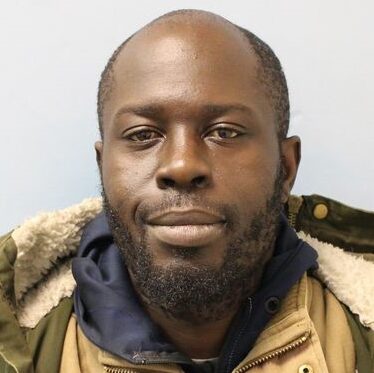
Deranged pot-head beat father-of-two to death
A mentally ill man bludgeoned his neighbour to death with a traditional African wood carving after his condition was worsened by constant cannabis smoking, a court heard.
Victor Osei, 41, used the ornament, which depicted a woman’s head, to repeatedly beat 62-year-old Anthony Higgins over the head.
He had been smoking pot every day for 25 years and could become violent again if he has another joint.
Police were called to Priestly House, Barnhill Road, Wembley, just after 10am on 12 September last year following reports that a man had been assaulted.
Inside they found the body of Mr Higgins, a father of two, who was pronounced dead at the scene.
A post-mortem examination identified multiple scalp lacerations, blunt force injuries to the face, fractures of the tongue and larynx, and defensive injuries to the upper limbs.
The cause of death was found to be multiple head, neck and chest injuries.
Osei denied murder but admitted manslaughter by diminished responsibility, a plea which was accepted by the Crown in light of Osei’s mental state.
Before the offence he had been discharged into the care of his GP for a number of months after being treated by a Community Mental Health Team.
Two psychiatric reports found Osei suffers from paranoid schizophrenia, compounded by substance misuse, which impacted his behaviour on the day of the killing.
Oliver Glasgow, prosecuting, told the court: ‘On Saturday 12 September 2020, Robert Bynoe, one of the residents of Priestly House, was disturbed by sounds coming from the defendant’s flat.
‘Mr Bynoe, like many of the other occupants of the building, had suffered because of the aggressive and violent behaviour of Victor Osei and at that time he took little notice of what he heard.
‘In due course, when Robert Bynoe was interviewed, he would describe the defend as erratic, violent and despicable.
‘He said he was someone who was always shouting and arguing and that he often carried a knife.
‘On the morning of 12 September, Mr Bynoe saw fireman and police officers attend shortly before 7am but, from what he could see, nothing was done.
‘PC Jakobicki, together with a team from the London Fire Brigade tried to enter flat 13 but found the front door was blocked by a fire extinguisher.
‘Once they had managed to get past the blockade, PC Jakobicki found that the flat was full of smoke and there was a strong smell of burning.
‘PC Jakobicki proceeded to search the flat and, when he entered the front room, he found Victor Osei sat in a chair looking out the window.
‘Victor Osei was not cooperative with any of the emergency services who entered his flat and it was apparent that the defendant appeared to have some sort of mental health difficulty.
‘But, despite the odd nature of some of the things that he said, PC Jakobicki concluded that Victor Osei did not lack capacity and so no further action was taken at that time as regards to whether he was fit to remain in the flat.’
A couple of hours later another neighbour, Bernard Ogwang, was awoken by a loud sound.
He opened his window and heard someone shouting as if in pain.
This went on for several minutes, and Mr Ogwang reported hearing the sounds of furniture being moved or broken.
He called the police returned.
Mr Glasgow said: ‘When Mr Ogwang opened his front door and looked along the balcony, he could see the feet of his neighbour, Anthony Higgins, lying in the doorway of his own flat.
‘Mr Ogwang slowly approached and, when he got closer, he could see that Anthony Higgins was covered in blood and there were serious injuries to his face.’
When police arrived at the scene they discovered blood leading in to Mr Osei’s flat.
Officers forced the door of the flat but before they could enter Mr Osei told them not to enter or he would shoot.
When Osei moved to prevent officers from entering the flat, one of the officers fired her taser.
Osei’s flat was covered in blood, subsequently found to be that of Anthony Higgins.
Addressing Osei’s mental state, Mr Glasgow told the court: ‘It is relevant that there is no alternative explanation for the defendant’s conduct but that afforded by the mental health disorder from which he suffers, and that he has limited previous convictions for violence.
‘However, in assessing culpability it is also relevant to note that the defendant’s condition was, in the view of the doctors, compounded by cannabis misuse.’
The court heard a statement from Claudette Brown, Mr Higgins’ younger sister, who said: ‘It is very hard to put into words what the loss of Tony has meant to us.
‘We are truly heartbroken.
‘He was a brother, a father, and grandfather. He was a very loving person; he was kind, he was humble.
‘We really struggle to understand how this could have happened at all.
‘We are the ones with the life sentence now.’
Addressing Mr Osei’s long-standing cannabis misuse, Dr Nigel Blackwood, a consultant forensic psychiatrist, told the court: ‘He clearly has misused potent skunk cannabis, he tells me from the age of 17.
‘He’s told me he’s only desisted from that during a period of imprisonment for a number of months, so that has been present for 25 years.
‘That’s an important factor that may have contributed to the development of his illness and may worsen some of the symptoms when he is psychotic,
‘That’s clearly demonstrated by the length of time it took clinicians to get him well after this assault.
‘It took them more than six months, with inpatient care and medication, to get him better, or largely better – and that’s in the absence of cannabis.
‘Cannabis abuse was important in increasing the risk of developing his disorder, and it can worsen the symptoms, so it is clear that he must desist in the future.’
Passing sentence The Common Serjeant of London, Judge Richard Marks said: ‘You are now 42 years of age. You have eleven convictions for 20 offences.
‘It is not a particularly attractive antecedent history and it includes an offence of actual bodily harm as well as two offences involving the possession of knives.
‘At the time of the events concerning this court you were resident at Priestly House in Wembley.
‘There had been a number of occasions when residents have had cause for complaint about your antisocial and disruptive behaviour.
Acknowledging members of Mr Higgins’ family in court, Judge Marks continued: ‘Anthony Higgins was a fine man. He was greatly loved and respected and, not unsurprisingly, his family are utterly devastated by his loss, especially by the circumstances in which it occurred.
‘During the post-mortem examination, 27 separate sites of blunt impact were identified to [Mr Higgins’] face and head.
‘He had clearly been subjected by you to a sustained and brutal assault which involved the use of a wooden carving.
‘Quite what precipitated this attack by you on him is unclear from the evidence.
‘I have read and considered the psychiatric reports in your case, all of which agree that at the time of the offence you were suffering from schizo-affective disorder, compounded by substance misuse.
‘Notable features of your history are non-compliance with medication and excessive use of cannabis.
‘I am greatly concerned with the protection of the public in general and I have no doubt that this would be best achieved by a hospital order.
‘Close psychiatric and social supervision would be in place when you were released, together with your rapid recall to hospital in the event your condition worsens.
‘It is evidence from the violent nature of this attack that when you are unwell and not properly medicated you are capable of becoming extremely dangerous.
‘In my view, very considerable care will be necessary in future before you are considered safe to be released into the community.’
Osei was returned to Three Bridges, a medium secure unit in Southall, West London, where he will continue his treatment.
He was detained under section 37 and 41 of the Mental Health Act. It will be for the doctors to say when, if ever he should be released.
Ends.


