
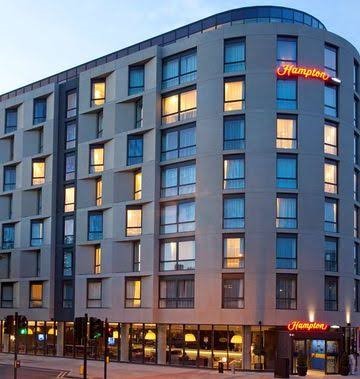
Businessman Boutros El Khoury claims financiers deliberately got him thrown out of his own hotel
A finance company kicked the new owner of a Hilton hotel out of the building after seizing control of his company, the High Court heard.
Lebanese hotelier Boutros El Khoury, 57, offered to buy the Hampton by Hilton at Waterloo for £108m earlier this year but claims he was shut out following disputes over funding evidence.
He instead convinced the owners of the debt-laden Project Q Senior Limited, which owned the central London hotel and the DoubleTree by Hilton York, to sell him their shares for £1.
But Mr El Khoury took Project Q’s financiers, Cohort Lendco II Limited to court claiming they wrongly appointed administrators for the company after it obstructed the sale of the hotel to make itself the preferred buyer.
His lawyers alleged that Cohort’s repeated delays were part of a deliberate strategy to allow default interest to mount, making it increasingly difficult for another buyer to purchase the property, before Cohort could ultimately ‘take the hotel’.
Barrister for Mr El Khoury, Iris Ferber, KC, told the court: ‘This application relates to the Waterloo hotel… it is not a case about typical remedies or enforcement actions of the lender.
‘It is rather a case which relates to a lender having an improper purpose in seeking to put a company in administration.’
Mayfair-based Cohort, a commercial property lender specialising in short-term bridging finance, acknowledges that it is not authorised or regulated by the Financial Conduct Authority.
Project Q put the hotel up for sale after it failed to repay a £94.5m loan from Cohort in November 2025 and began accruing a default debt interest of £2m a month.
But Ms Ferber said Cohort CEO Matthew Thame actively delayed attempts by Mr El Khoury to buy the hotel as early as January 2026 with vexatious demands.
He had advised Dmitry Mints, Project Q’s head of real estate, to demand a £1m non-refundable exclusivity payment as part of an initial memorandum of understanding (MOU).
But the court heard this did not actually guarantee exclusivity, as the hotel was already being sold in a parallel process run by real estate giant JLL.
In the witness box, Mr Thame insisted he had done everything correctly and his company stands to lose money on the deal.
‘We were constantly being asked to give our view and give feedback because that was the relationship we had with Mr Mints… I didn’t want to get involved in this MOU.
‘When Dmitry asked me if there were any additional things we could add into Boutros’s bid to demonstrate it was concrete and credible, we both discussed the idea of a non-refundable payment, which is usual for a bid or offer of this size.’
Asked by Ms Ferber whether he accepted it was ‘abnormal’ to demand payment from a bidder outside of an ongoing sale process, the financier said: ‘Yes.’
She added: ‘If Mr El Khoury had handed over a million pounds in non-refundable payment… you could make a bid through JLL once default interest got high enough.
‘That would have been accepted, and you would have kept the million pounds as well.’
Mr Thame replied: ‘I didn’t think of it that way… I didn’t want to get into the finer details of this MOU, but the discussions I was having with Mr Mints at the time were that if Mr El Khoury was going to put down the million pounds, he could have the exclusivity.
‘He could have exclusivity, he could have the hotel… we wanted to sell this hotel alongside Mr Mints, so any way we could do that and assist with that, we were open to.’
But he insisted: ‘I was not once asked to give consent [to the MOU] and bless it.’
Ms Ferber said: ‘I am going to suggest to you that is untrue, and I remind you when Mr Mints sent you the MOU on 30 April, he told you it was the agreed final form.
‘He was not asking to advise, he was asking for your consent.’
When Mr El Khoury wrote to Cohort after months of delay, saying: ‘Please get on with it and let the Company [Project Q] sign the heads of terms’, Ms Ferber said: ‘This was about you.’
She added: ‘[El Khoury’s lawyer] is saying on record he heard Mr Mints say it was you stopping him from signing the MOU because you wanted a million pounds non-refundable deposit.’
She said this was insisted upon despite Mr El Khoury’s offer of £5m in stakeholder deposit, adding: ‘It was you putting up the hurdle, putting up the £1m, not the Company.
‘What you didn’t do, after all this to-and-fro, is permit the Company to sign this MOU with the exclusivity agreement and get on with the parallel exchange.’
The court heard El Khoury eventually agreed to proceed without exclusivity, only that the Cohort would not sell the hotel to a buyer with an equal or lower offer.
But Mr Thame refused the offer of £108m and asked Mr El Khoury to submit a formal bid through the ongoing JLL process – some three months after he began negotiating to buy the hotel.
Ms Ferber said: ‘He was willing to deposit £5m, then he was willing to deposit £10.8m, or 10 per cent of the offer. His solicitors had seen his bank statements and term sheets.
‘Instead you decided, you, Mr Thame, to give Mr El Khoury access to the [bidding] data and required him to go through JLL.’
The court heard Mr El Khoury did not submit a formal bid, but Mr Thame acknowledged: ‘On the face of it, he [El Khoury] had the highest offer… It was a disappointing outcome.’
Disillusioned that the bids had not levelled in the JLL sale, Mr Mints transferred his shares of Project Q to Mr El Khoury for just £1 on 4 June, making him sole director of the company.
Eleven days later Cohort appointed administrators to the company and removed Mr El Khoury from the Waterloo hotel, claiming he was ‘interfering’ with the hotel’s operations.
Ms Ferber put it to Mr Thame: ‘You didn’t agree to the MOU because you didn’t want Mr El Khoury to buy the hotel… You knew you were sitting on a much, much higher value asset.
‘The reality is that at the time when Mr El Khoury was putting forward his bid on the 13th of April, and indeed before the 13th of April, your view as a company was this was a valuable asset worth £131m a year before.
‘You were going to delay things, increase the default interest, allow the default interest rather to take the debt to a point where no one else could buy other than you, and then you were going to take the hotel.’
Mr Thame replied: ‘No, that was never our intention, I was completely impartial as to who bought the hotel,’ but added: ‘We were 100 per cent interested in redeeming our debt.’
But Ms Ferber suggested: ‘If you owned the hotel, you could sell it when you liked… not in a fire sale, under high debt, could be worth over £130m. That is an asset that is attractive for you to own.’
Mr Thame said: ‘Forcing the borrower and the property structure into administration was not ever our intention.
‘We never wanted this to be an administration scenario and for it to end up in the place we wanted now.
‘We’ve not crystallised any return on the capital yet. We’ve not sold or refinanced the position so we cannot confirm any profit to be made.
‘I’m not sure how much we are going to make or lose here. This could be a hugely loss-making exercise.’
Ms Ferber said: ‘I suggest to you that is an entirely self-serving answer and in reality, you are, if this application is unsuccessful, going to be sitting on two assets that were a year ago worth £131m.
‘You stand to make a serious profit from the way you have conducted yourself in this matter.’
Mr Thame said: ‘I don’t know what the outcome of this is going to be, but it is clear the asset is not worth £130m.’
A reserved judgement is expected at a later date.


